
Manhattan City Directory Holdings
The Riley County Genealogical Society catalog supplies the clearest year-by-year view of Manhattan city directories. It documents early Blue Books, a Republic-Mercury title, long Polk runs, telephone books, and rural issues. The gaps should remain visible because no source supports a continuous annual series.
| Collection | Years | Where Held | Access |
|---|---|---|---|
| Riley County Blue Book and Directory | 1884-85; 1890-91 | Riley County Genealogical Society | Reference; confirm hours |
| Republic-Mercury directory | 1911, with index | RCGS and local historical collections | In-person reference |
| Polk Manhattan directories | 1911; 1939; 1949; 1956; 1958; 1960-74; 1976-91; 1995 | RCGS and local collections | Ask for exact volume and street section |
| County-including Polk volume | 1998 | RCGS catalog | Reference |
| Telephone directories | 1919-2012 | RCGS and library collections | Name, address, and phone clues |
| Rural directories | 1967-74; 1977-78 | RCGS | County and farm context |
The catalog also points to survey-listed Polk volumes held at the Riley County Historical Society and Kansas Historical Society. Verify each shelf location before travel. A single last printed Manhattan year was not established, though the catalog reaches Polk material into 1998 and telephone books through 2012.
Early Manhattan Directory Years
The earliest verified local starting points are the Riley County Blue Books for 1884-85 and 1890-91. A 1909 Directory and Atlas and Year Book covers Manhattan and adjacent territory, a useful phrase for people whose farm, township, or road did not fit the later city grid. The 1911 Republic-Mercury directory likewise includes surrounding townships.
These titles should not be read as modern city-only lists. County, farm, civic, and business context can sit beside Manhattan entries. Save the exact title and publisher language because it defines the area represented in that volume.
Later Polk issues are plentiful but uneven. Their verified years include long runs from 1960 through 1991 with gaps, plus earlier single years and 1995. Missing years can be bridged through telephone books, tax books, census schedules, newspapers, and deeds.
Manhattan Directory Research Desks
Manhattan Public Library's Kansas History Cabinet holds local histories, plat books, indexes, church histories, rare photobooks, and research works tied to Riley County. City directories are in the second-floor Reference collection, while some telephone and yellow-page material is in the first-floor Reading Room. Cabinet items do not check out, but staff may allow photographs or scans.
The Riley County Historical Society adds city and telephone directories, 1862-1920 tax books, historical survey files, newspapers, family and photo files, court and cemetery material, maps, yearbooks, and city clerk records. Library service is appointment-only. The Riley County Genealogical Society is the best first call for an exact issue and whether it contains an address-ordered section.
For state-level gaps, K-State Hale Library and University Archives offer yearbooks, campus publications, Sanborn microfilm, and special collections. The Kansas Historical Society in Topeka holds additional newspapers, county series, and selected Polk years.
Note: Call before travel to confirm the volume, shelf, hours, and whether staff can provide a scan or reference lookup.
Inside Manhattan's History Cabinet
The official Kansas History Cabinet resource list shows why a directory hit can lead well beyond a name and address.
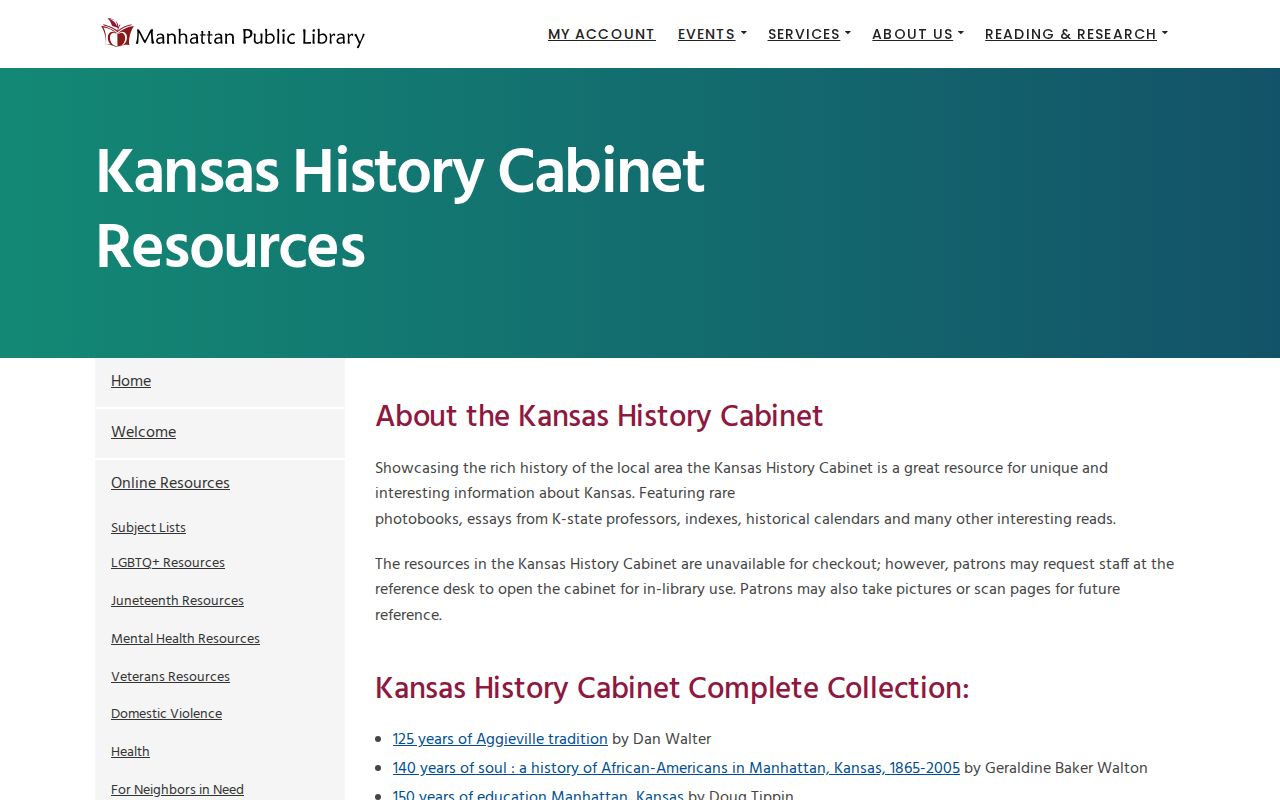
Once a city directory places a person in a year, a plat book can fix the lot, a church history can explain an institution, and a local name index can point to a fuller file. Each remains a separate source with its own meaning.
Read a Manhattan Directory Entry
Start with the alphabetical headword exactly as printed. Record initials and variant spellings, then capture any relationship, residence, business, occupation, telephone, or status mark that the volume actually defines. No direct image of a named local entry was verified, so the fields below are an inventory to transcribe, not a fabricated example.
| Name | Surname, given name, initials, and printed spelling |
|---|---|
| Relationship | Spouse, wife-of, widow-of, or household notation when present |
| Residence | House number, street, room, or residence abbreviation |
| Work line | Occupation, firm, shop, office, or institution when supplied |
| Telephone | Exchange and number in applicable telephone issues |
| Citation | Volume year, publisher, page, and abbreviation key |
- Criss-cross directory
- A street-and-house-number arrangement that reverses the usual surname order.
- Householder index
- An address-based list of the named person associated with a household entry.
- Abbreviation key
- The volume's own legend for short forms and status marks; photograph it before interpreting entries.
A label such as owner, boarder, student, or widow should be used only when that issue's key confirms it. Directory compilers changed conventions, and a telephone book may list subscribers differently from a Polk volume.
Alphabetical or Manhattan Street Order
Most directory work begins with a surname, but a reverse section begins with an address. That second arrangement is valuable when the only clue is a house number or when several listed people share a block. Local sources confirm city and telephone directories, yet they do not prove that every Manhattan volume has a complete criss-cross section.
Ask RCHS or RCGS about the exact year. If the issue lacks street order, use the alphabetical listing to capture the address, then compare a tax book, plat, or census. For current parcel work, use the Manhattan street directory process rather than forcing a historic volume to answer a modern ownership question.
Manhattan Directories Meet Newspapers
The Manhattan Public Library microfilm index spans many local titles, including the Manhattan Beacon, Manhattan Enterprise, Kansas Telephone, Manhattan Republic, Daily Mercury, Morning Chronicle, and Manhattan Mercury runs. It also lists a Riley County obituary index for 1957-1975.
A directory gives a dated placement. A newspaper may explain a move, death, land sale, school event, club role, or business change. Preserve the newspaper title, date, page, and reel because optical text recognition can misread both surnames and streets.
The second successful collection image comes from the Riley County Genealogical Society catalog, which documents the exact local runs.
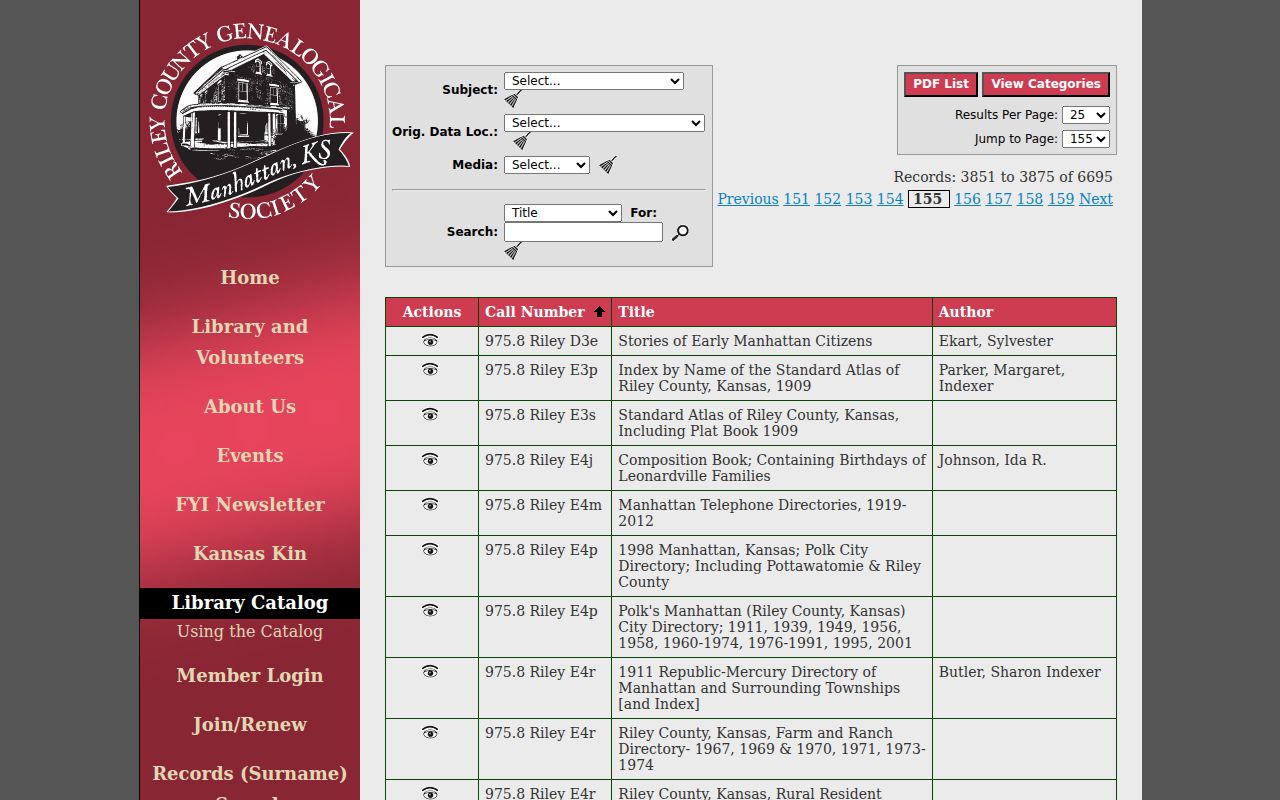
Use the catalog to request the right volume, then cite the page from the volume itself. A catalog row proves the holding, not the content of an individual entry.
Manhattan Names Changed in 1908
Manhattan's address history can hide an entry that is otherwise present. Postal numbering grew during the early 1900s, and the city corrected block numbering and street names in 1908. The numbered sequence on a circa-1885 plat does not match the modern grid in every case. Old Eliza Street and Fort Riley Boulevard, railroad-side names, and former alleys also need paired searches.
Record the old name, new name, old block, new block, lot, and nearest fixed landmark. Then compare the 1881 or 1909 plat, Sanborn years from 1905 through 1947, the city survey, and the next directory issue. A failed modern address search may be a naming problem rather than a missing household.
Note: Keep both street strings in the citation so another researcher can repeat the search without guessing which grid was used.
The 1951 Manhattan Archive Gap
The 1951 flood damaged downtown Manhattan and caused extensive loss of books and periodicals at the public library. This local story explains why no single shelf should be treated as a complete run. Surviving directories may need support from historical-society files, tax books, plats, newspapers, photographs, and later issues.
If a name or address vanishes near the flood, compare issues before and after the event. Look for rebuilding permits, property transfers, obituary notices, relocation news, or changed street descriptions. Flood damage is one possible cause, not a fact to assign to a family without direct evidence.
Trace Families in Manhattan Directories
City directories work best as dated checkpoints between census years. Begin with a verified spelling and one likely year. Follow the same person through nearby issues, retaining address, spouse or relationship mark, work line, telephone, and all signs that the compiler recorded a move or death.
- Find the earliest likely Manhattan entry and capture the full page citation.
- Check the next available issue, noting spelling, address, phone, relationship, and work changes.
- Use the street section, if present, to test the address and nearby listed households.
- Pair directory checkpoints with released federal census schedules and local tax books.
- Close a disappearance with newspapers, the obituary index, cemetery records, deeds, or probate evidence.
Absence has several possible causes: a move, death, unlisted telephone, publication gap, indexing error, or changed address. The city directory alone cannot choose among them. A second independent source should supply the event and date.
Keep the surrounding territory in view. The 1909 Directory and Atlas and Year Book covers Manhattan and adjacent territory, while the 1911 Republic-Mercury title includes surrounding townships. Rural directories from 1967-1974 and the 1977-78 Rural Resident Directory may catch a family outside the city grid. K-State yearbooks and Hale Library collections can add a dated university link, and cemetery or church files may explain a later gap. Record each source's geographic scope before deciding that two entries refer to one household. A volume's title page, publication year, abbreviation key, and page number belong in every citation. Those details make the entry findable again.